What neuro rehabilitation is, and who it helps
Neuro rehabilitation is physiotherapy for people whose difficulty with movement comes from the nervous system — the brain, the spinal cord, or the nerves that carry instructions to the muscles — rather than from a joint or a muscle alone. A stroke, a spinal injury, Parkinson's disease or a nerve condition can take away things that were once automatic: standing up, crossing a room, holding a cup steadily.
This is the department at Navthera in Jaipur that works on exactly that. The nervous system is able to relearn, and rehabilitation is the structured, repeated practice that helps it do so — safer movement, fuller use of the arms and legs, and as much daily independence as your condition allows.
- Stroke (paralysis, weakness, speech & balance issues)
- Spinal cord injury (paralysis, walking difficulty)
- Traumatic brain injury (head injury recovery)
- Parkinson's disease
- Multiple sclerosis
- Cerebral palsy
- Bell's Palsy
- Peripheral nerve injuries
- Neuropathies (including diabetic neuropathy)
- Guillain-Barré syndrome
- Motor neuron disease (ALS)
- Muscular dystrophy and myopathies
- Polyneuropathy
- Brain tumor or neurosurgery recovery
- Spinal surgery recovery
- Transverse myelitis
- Functional neurological disorders
- Ataxia and coordination disorders
- Difficulty walking or standing
- Balance disorders and frequent falls
- Tremors and movement disorders
- Postural instability
- Severe weakness or loss of coordination
- Developmental delay
- Dyspraxia
- Pediatric movement disorders
- Dementia-related mobility decline
- Age-related neurological weakness
- Neurogenic bladder and bowel dysfunction
- Loss of independence in daily activities
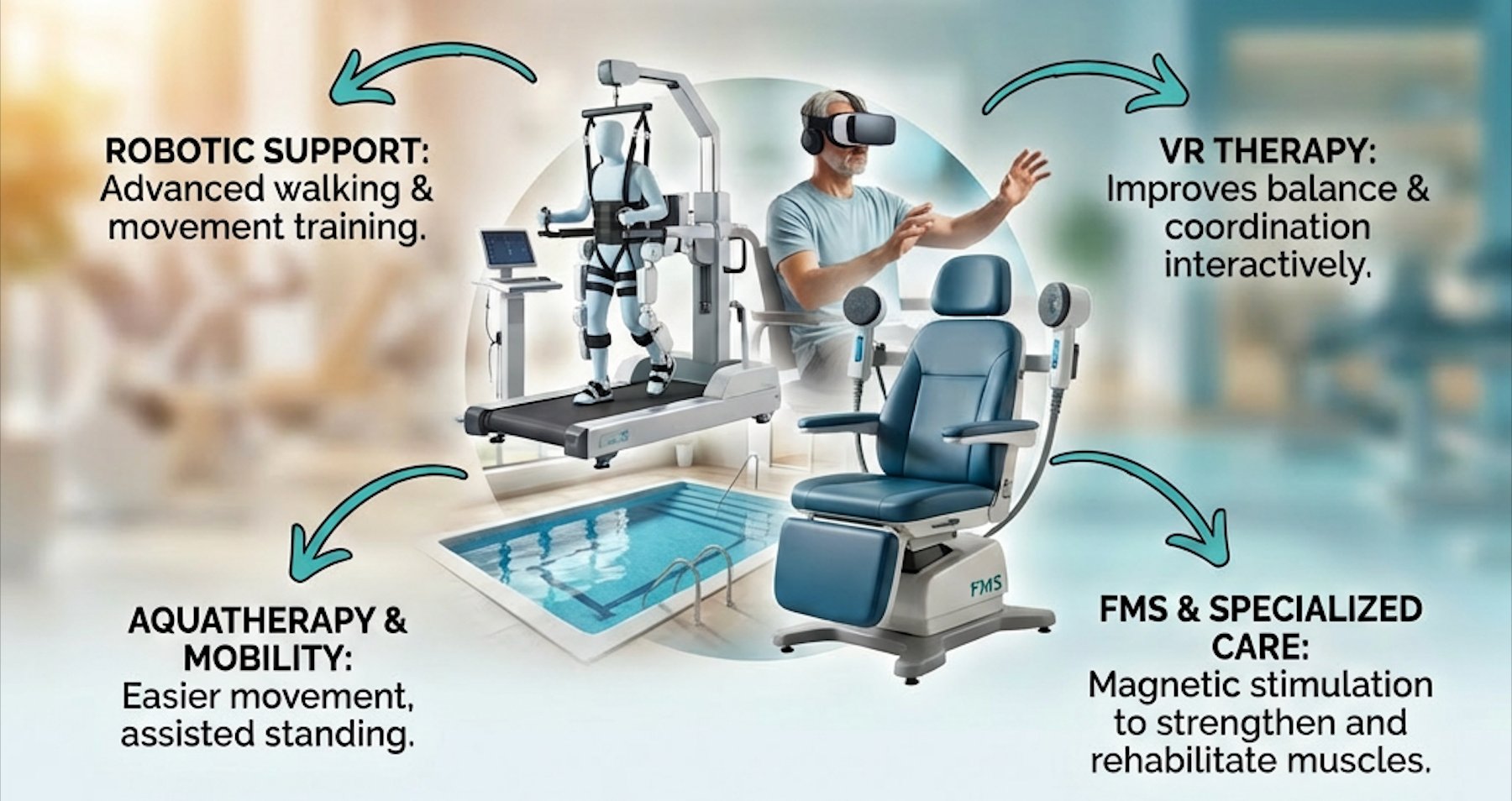
Brain Relearning
Intensive, repetitive training helps the brain rebuild neural pathways through neuroplasticity - the key to neurological recovery
Earlier Mobilisation
Robotic support enables walking and standing training even for patients who cannot move independently - no more waiting
Pain-Free Practice
Water therapy and VR create safe, engaging environments where patients move without fear of falling or joint stress. Learn more about aquatherapy benefits for neurological patients.
Faster Independence
Combined technologies increase therapy intensity, improving walking, hand use, balance, and daily activity function significantly faster
How rehabilitation helps, by condition
Stroke and brain injury
After a stroke or head injury, one side of the body is often weak, and muscles can tighten and resist movement. Rehabilitation is structured, repeated practice of ordinary actions — sitting up, walking, using the affected arm — until the nervous system relearns them. FES uses electrical stimulation to activate muscles too weak to switch on by themselves, and virtual reality turns that repetition into tasks you can see and respond to.
Spinal cord injury and spinal conditions
When the spinal cord is injured, movement and sensation below that level are affected, and sitting balance, transfers and standing have to be relearned. Rehabilitation builds on the muscles that still respond: an active passive trainer moves the legs for someone who cannot yet move them and assists as effort returns, while the aquatherapy pool takes weight off the body so upright practice becomes possible. Bladder control is often affected too, and the FMS chair uses magnetic stimulation to activate and strengthen the pelvic floor while you stay fully clothed — work shared with pelvic health physiotherapy. Recovery after spinal surgery overlaps with orthopaedic rehabilitation.
Parkinson's, MS and progressive conditions
In Parkinson's disease, movements become smaller and slower, steps shorten and turning can bring hesitation or a sense of freezing; multiple sclerosis and other progressive conditions add weakness and fatigue. Rehabilitation does not change the underlying condition, but it works on deliberately large, well-cued movement, steady balance practice and pacing that respects your energy. I-Gait, a robotic gait training system, supports the legs so walking can be practised in a controlled, repeated way.
Nerve injuries and neuropathies
When a nerve is damaged — by diabetes, by pressure or injury, by Bell's palsy, or after Guillain-Barré syndrome — the muscles it supplies weaken and sensation is often dulled. Rehabilitation rebuilds those muscles gradually and teaches you to protect a limb that can no longer feel properly. EMG biofeedback shows your own muscle activity on a screen as it happens, which helps when you are learning to switch a quiet muscle back on.
Children and older adults
In children with cerebral palsy or developmental delay, rehabilitation works alongside growth: practising the movements a child is ready for, keeping muscles long and joints comfortable, and using play so the repetition is willing rather than forced. In older adults the concern is usually unsteadiness and falls, where the work is strength, confident walking and safe balance, overlapping with geriatric physiotherapy and balance and vestibular rehabilitation.
Frequently Asked Questions
Yes. Brain imaging shows that with intensive, repetitive training, neural pathways can be rebuilt even years after stroke. The earlier you start rehabilitation at Navthera in Jaipur, the greater your recovery potential - but it's never too late to improve.
Recovery timelines vary greatly depending on your condition, severity, and starting point. Most patients see meaningful improvement within 4-8 weeks of consistent therapy, but ongoing rehabilitation over 3-6 months often produces the best results in movement, strength, and independence.
Absolutely not. Robotic-assisted training at our Jaipur centre allows patients to begin walking and standing practice even when completely unable to move independently. The robot provides support, and as you progress, that support decreases until you walk on your own.
Yes, when performed by trained specialists with medical supervision. Starting rehabilitation early is actually protective - keeping muscles active, improving circulation, and preventing secondary complications. We coordinate closely with your doctor to ensure safety.
General physio addresses muscle and joint issues. Neuro rehabilitation specifically targets the nervous system - retraining the brain's control of movement through repetitive practice, VR feedback, and robotic guidance. This specialist approach unlocks recovery that standard physio alone cannot achieve.
Yes. VR therapy and robotic support are specifically designed to work with progressive conditions like Parkinson's and MS. The goal is slowing decline, improving walking and balance, and maintaining independence as long as possible - which makes an enormous difference in quality of life.
Booking an assessment
Navthera Advanced Physio and Rehab Centre is at 68, Shri Gopal Nagar, Gopalpura Byepass, Jaipur. To arrange a neuro rehabilitation assessment, call +91 97845 32400, email contact@navthera.in, or message us through the contact page.