What orthopaedic physiotherapy treats
Orthopaedic physiotherapy deals with pain and lost movement coming from the musculoskeletal system — bones, joints, discs, muscles and tendons — whether the problem arrived slowly with age, suddenly with an injury, or as part of recovering from an operation.
This is that department at Navthera in Jaipur: the back gone into spasm, the knee that will no longer manage stairs, the shoulder that has stopped reaching overhead. Treatment begins from two questions — what is producing the pain, and what has it stopped you doing? The aim is to settle symptoms enough that movement becomes possible, then rebuild the strength and range that pain and rest take away.
- Slip disc / herniated disc
- Sciatica
- Chronic back pain / Lumbar Spondylosis
- Neck pain and cervical spondylosis
- Postural problems
- Spinal degeneration
- Post-spine surgery rehabilitation
- Knee pain and osteoarthritis
- Hip pain and arthritis
- Shoulder pain and impingement
- Frozen shoulder
- Elbow pain (tennis elbow, golfer's elbow)
- Wrist and hand pain
- Heel Pain
- Knee replacement rehab
- Hip replacement rehab
- Shoulder surgery rehab
- Ligament reconstruction rehab
- Fracture fixation recovery
- Post-fracture stiffness and weakness
- Joint stiffness after immobilization
- Loss of movement after injury
- Arthritis and joint degeneration
- Age-related joint pain
- Fibromyalgia
- Long-standing musculoskeletal pain
- Difficulty walking or climbing stairs
- Reduced strength and mobility
- Workplace or posture-related pain
- Obesity-related joint stress
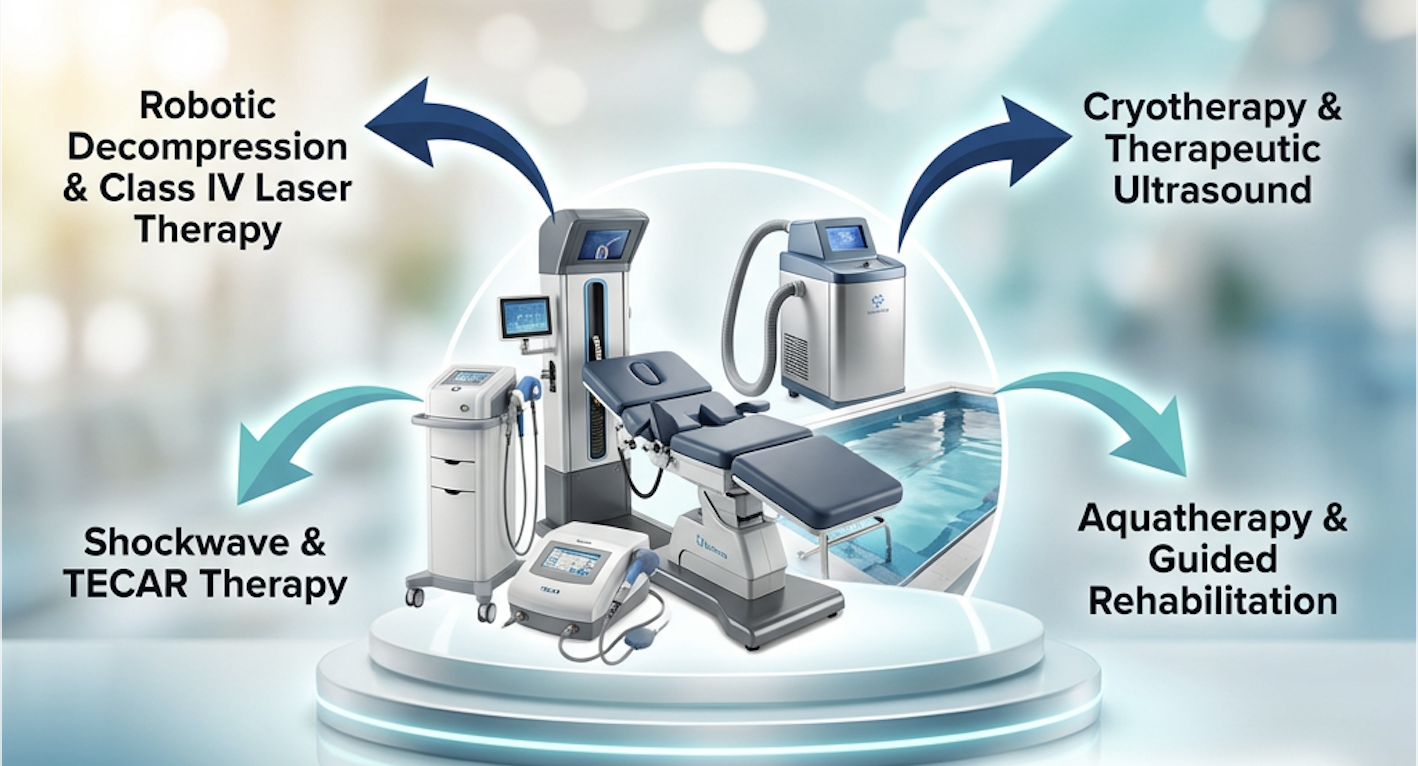
Non-Surgical Pain Relief
Advanced technologies target the root cause of pain - not just the symptoms - reducing reliance on medication and avoiding surgery
Deeper Healing
Laser, TECAR, and shockwave penetrate deep tissues where basic physiotherapy cannot reach, stimulating repair at the cellular level
Joint Decompression
Robotic systems precisely reduce pressure on discs and nerves, often improving mobility and reducing radiating pain. For post-operative rehab, aquatherapy provides excellent recovery acceleration.
Faster Functional Return
Combining pain-relief tech with structured strengthening gets patients back to walking, climbing stairs, and daily life faster
How rehabilitation helps, by condition
Slip disc and sciatica
When a disc presses on a nerve root, the pain does not stay in the back — it runs into the buttock and down the leg, often with numbness or tingling, and sitting makes it worse. Rehabilitation works to ease that pressure, give the spine back the movement it has been guarding, and strengthen the hips and trunk around it. Robotic decompression applies controlled, computer-guided traction alongside that exercise work.
Back and neck pain, spondylosis, posture
Spondylosis is wear in the discs and small joints of the spine: stiffness first thing, pain that builds through a long day at a desk, sometimes headaches that start in the neck. Rehabilitation works to free the segments that have stiffened, retrain the deep muscles that hold your head and lower back steady, and change how you sit and lift. TECAR, radiofrequency that warms tissue at depth, can settle a guarded area beforehand.
Knee and hip pain, and osteoarthritis
Worn knee and hip joints hurt most under load — stairs, getting out of a chair, the first steps of the day — and the muscles around them weaken as you move less. Rehabilitation rebuilds thigh and hip strength, works back the range the joint has lost, and retrains walking. When exercise on land is still too sore, the aquatherapy pool lets you work with buoyancy taking load off the joint.
Shoulder, elbow, wrist and heel pain
Tendon and shoulder problems follow a pattern: pain on one particular movement, pain at night, and reach or grip quietly disappearing. Rehabilitation loads the tendon in careful stages so it tolerates work again, frees a shoulder that has tightened, and corrects the shoulder-blade control behind much of it. Shockwave, pressure waves used for long-standing tendon problems, may be part of that; sports injuries may suit sports rehabilitation.
Recovery after surgery
After a knee or hip replacement, a ligament reconstruction or fracture fixation, the joint is swollen and stiff and the muscles around it stop firing properly. Rehabilitation follows your surgeon's protocol — settling swelling, recovering safe range, then loading the limb again through standing, stairs and walking. Cryotherapy uses controlled cold for pain and swelling, and FES, electrical stimulation, helps switch a quiet quadriceps back on.
Stiffness after immobilisation, and long-standing pain
Time in a cast or sling leaves a joint stiff and the muscle around it wasted, and long-standing pain leaves the whole body deconditioned and wary of moving. Rehabilitation works range back into the joint, rebuilds the strength that disuse takes, and steps activity up at a pace your body accepts. LASER, a light-based therapy for pain and healing, may be used; where falls and frailty dominate, geriatric physiotherapy may fit better.
Frequently Asked Questions
TECAR is capacitive and resistive energy transfer — a radiofrequency-based therapy that warms tissue at depth, which helps increase local blood flow and supports the body's own tissue repair. We use it mainly for chronic stiffness and long-standing joint and soft-tissue pain, where warming an area first makes mobility and strengthening work more comfortable. It is used alongside exercise-based rehabilitation, not instead of it.
Shockwave sends precise energy pulses into damaged tendons and ligaments, triggering the body's healing response. It breaks up calcifications, improves blood flow, and promotes new tissue formation - making it particularly effective for chronic tendon injuries where healing has stalled.
Yes. While we cannot reverse arthritis, laser and cryotherapy control pain and inflammation, allowing proper strengthening. Combined with aquatherapy and mobility work, many arthritis patients in Jaipur experience significantly reduced pain and improved movement.
This depends on your surgery type and surgeon's protocol. Typically, gentle movement can begin within days of surgery, with progressive loading over weeks. Our physios coordinate with your surgeon to start rehabilitation at exactly the right time for optimal healing.
Most patients experience reduced pain within 2-4 weeks, improved movement within 6-8 weeks, and return to normal function within 8-12 weeks. Individual results vary, but consistent treatment typically produces steady, measurable improvement you can feel week to week.
Yes, completing the full program prevents re-injury and recurrence. Pain relief is the first milestone, but true healing requires continuing strengthening and movement restoration. Our therapists guide you when active treatment can shift to maintenance exercises you do at home.
Booking an assessment
Navthera Advanced Physio and Rehab Centre is at 68, Shri Gopal Nagar, Gopalpura Byepass, Jaipur. To book an orthopaedic assessment, call +91 97845 32400, email contact@navthera.in, or send a message from the contact page.