Pediatric physiotherapy is not a scaled-down version of adult physiotherapy. Children are not small adults — their nervous systems are still developing, their bones are still growing, and their goals are different. A child does not want to "return to normal." They want to sit up, crawl, walk, run, play with other children, go to school. Pediatric rehabilitation is about getting them there, or as close to there as their condition allows.
What pediatric physiotherapy actually does
The focus is on improving a child's movement, posture, balance, strength, coordination, independence, and participation in daily activities. Pediatric physiotherapists work with children who have neurological, developmental, musculoskeletal, and motor-control difficulties.
The key word is functional. The goal is never just to improve a test score — it is to help a child do the things that matter: hold their head up, sit without support, stand, walk, climb stairs, dress themselves, keep up with classmates. Every treatment plan is built around what that particular child needs to achieve next.
Conditions that benefit from pediatric rehabilitation
The range is wider than most families expect. These are the conditions where pediatric physiotherapy plays a meaningful role:
Neurodevelopmental conditions
Neurological conditions
Musculoskeletal and other conditions
Treatment depends on the child's diagnosis, age, functional level, medical status, and individual goals. A child with ASD, for example, may require very different physiotherapy goals from a child with CP.
Five common conditions and how they are treated
Cerebral Palsy
CP is a group of disorders affecting movement and posture, caused by disturbances in the developing brain. Children may have spasticity, weakness, poor balance, abnormal gait, and difficulty with functional activities. Treatment uses neurodevelopmental handling techniques, trunk control and gait training, stretching and contracture prevention, strengthening, and where clinically appropriate, body-weight-supported treadmill training, functional electrical stimulation, and aquatic therapy. The goal is to improve functional movement, independence, and participation in daily life.
Down Syndrome
Commonly associated with low muscle tone, ligament laxity, delayed motor milestones, and difficulties with balance and coordination. Physiotherapy focuses on developmental milestone facilitation, core and lower-limb strengthening, balance and postural control, and functional transitions — from floor sitting to standing to walking, stair climbing, jumping, and coordination. Aquatic therapy is particularly useful here for movement practice and building confidence.
Autism Spectrum Disorder
Some children with ASD also have sensory processing differences, low muscle tone, coordination difficulties, toe walking, or delayed gross motor skills. Physiotherapy addresses balance, coordination, motor planning, postural control, and gait. Obstacle courses, functional play, and aquatic therapy are used to improve movement, physical participation, and independence. Sensory integration itself is a specialized approach generally delivered by an occupational therapist — pediatric PT provides the sensory-motor and movement-based interventions as part of a coordinated plan.
Global Developmental Delay
GDD refers to significant delay in two or more developmental domains in young children. Early intervention is key: head and trunk control training, rolling, sitting, crawling, standing, walking — each milestone built on through play-based motor learning. Parent home programmes and caregiver education are a central part of treatment, because what happens between sessions matters as much as what happens during them.
Developmental Coordination Disorder
Children with DCD struggle with coordinated motor skills — running, jumping, catching, handwriting-related tasks, dressing. Treatment is task-oriented: practising the specific skills that are difficult, alongside balance and coordination work, ball skills, motor planning, and bilateral coordination. The goal is confidence and participation in age-appropriate activities, not perfection.
What we offer in pediatric rehabilitation at Navthera
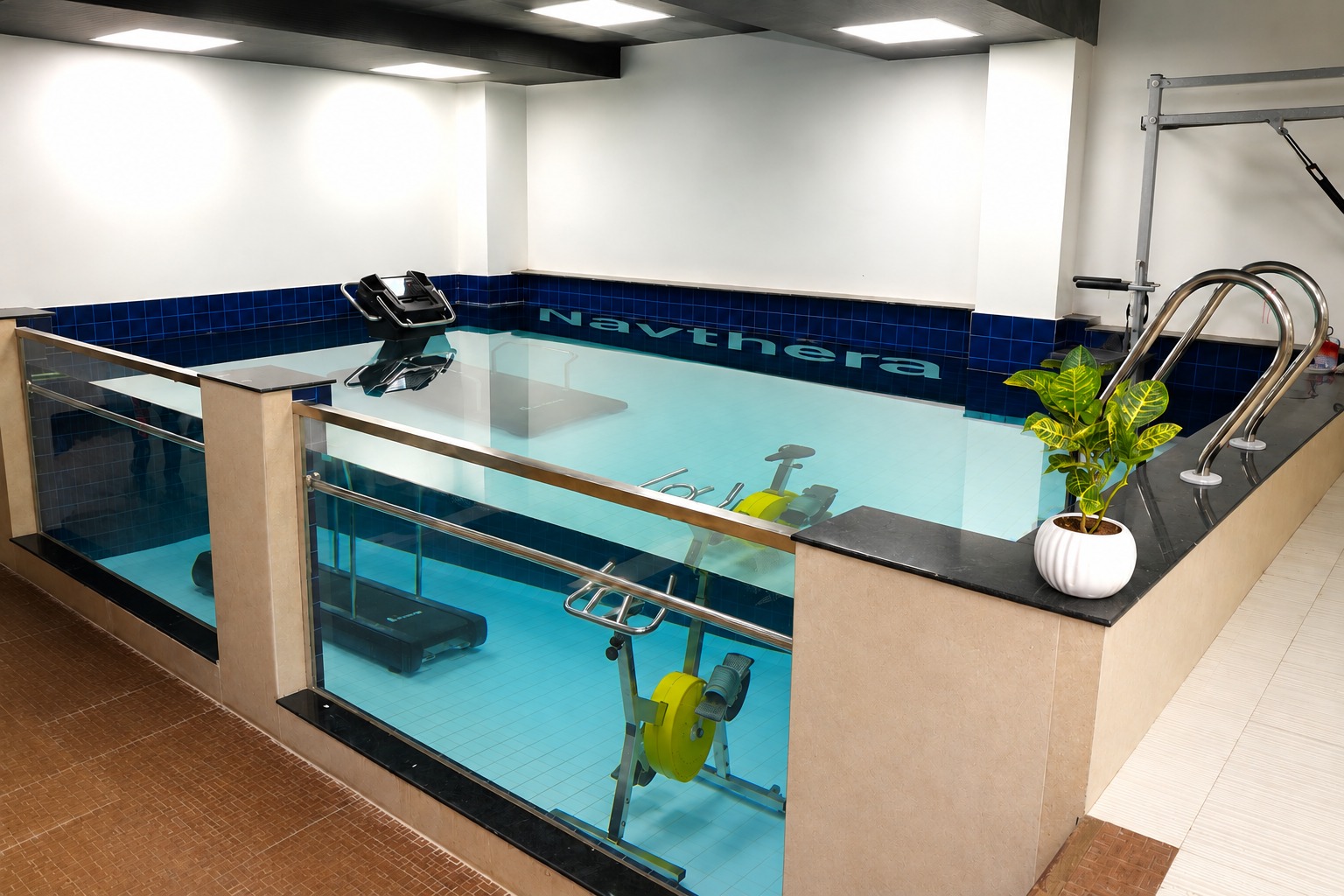
Our pediatric rehabilitation programme is led by Dr. Arundhati Mahori, who brings extensive clinical experience in treating children with cerebral palsy, developmental delay, and neurological conditions. The programme combines physiotherapy, occupational therapy, speech therapy, vision therapy, and aquatic rehabilitation according to each child's needs.
Halliwick Aquatic Therapy
Halliwick is a structured aquatic approach that helps children learn water independence, balance, and rotational control. We use it for mental adjustment and water confidence, breath control, buoyancy-assisted movement, and functional aquatic activities. It is particularly effective for children with CP, ASD, Down syndrome, and developmental delay. Research reviews report improvements in aquatic skills and gross motor outcomes in some children with CP, although study quality and protocols vary across the literature.
Body-Weight-Supported Treadmill Training
A harness and partial body-weight support allow a child to practise walking on a treadmill with appropriate assistance — repetitive stepping, weight shifting, gait symmetry, and progression from supported to more independent walking. Used for children with CP, developmental delay, and neurological conditions affecting gait.
Functional Electrical Stimulation
FES uses controlled electrical pulses to activate muscles during functional movement — assisting ankle dorsiflexion during walking, for instance, or facilitating muscle recruitment during rehabilitation. It requires individual assessment and trained clinical supervision, and is not suitable for every child.
Manual rehabilitation
Hands-on techniques alongside active exercise: gentle range-of-motion work, soft-tissue techniques, positioning, stretching, muscle activation, and preparation for functional activities like sitting, standing, and walking.
Oro-motor and oculo-motor rehabilitation
For children with oral-motor difficulties affecting feeding and swallowing, we provide lip, tongue, and jaw coordination work in coordination with speech and feeding specialists. For children with visual-motor difficulties, oculo-motor rehabilitation addresses eye tracking, visual fixation, saccadic exercises, and eye-hand coordination — always under appropriate professional supervision and following assessment by an optometrist or ophthalmologist.
Why early intervention matters
The developing brain is more plastic — more capable of reorganising — than the adult brain. The earlier rehabilitation begins, the more it can shape how the child's nervous system develops. This does not mean there is a deadline after which nothing works. Children continue to make gains at all ages. But starting early, when the brain is most receptive, gives every other intervention a stronger foundation to build on.
If your child has been diagnosed with any of these conditions — or if you have concerns about their movement, milestones, or coordination — a physiotherapy assessment is a practical first step. It tells you where the child is, what is achievable, and what a structured programme would look like.
Where to start
Dr. Arundhati Mahori and the pediatric rehabilitation team at Navthera see children across the full range of conditions described above. A first visit is typically an assessment — understanding the child's diagnosis, current functional level, and goals — followed by a treatment plan tailored to that child. Whether the diagnosis is recent or the child has been receiving therapy elsewhere and you are looking for a more specialised programme, the contact page is the place to begin.
This article is general information based on clinical guidance from Dr. Arundhati Mahori. It is not a diagnosis or a treatment plan. Please discuss your child's situation with their doctor or physiotherapist.